Free public transport in Luxembourg: buses, tram, trains, bikes and cars explained
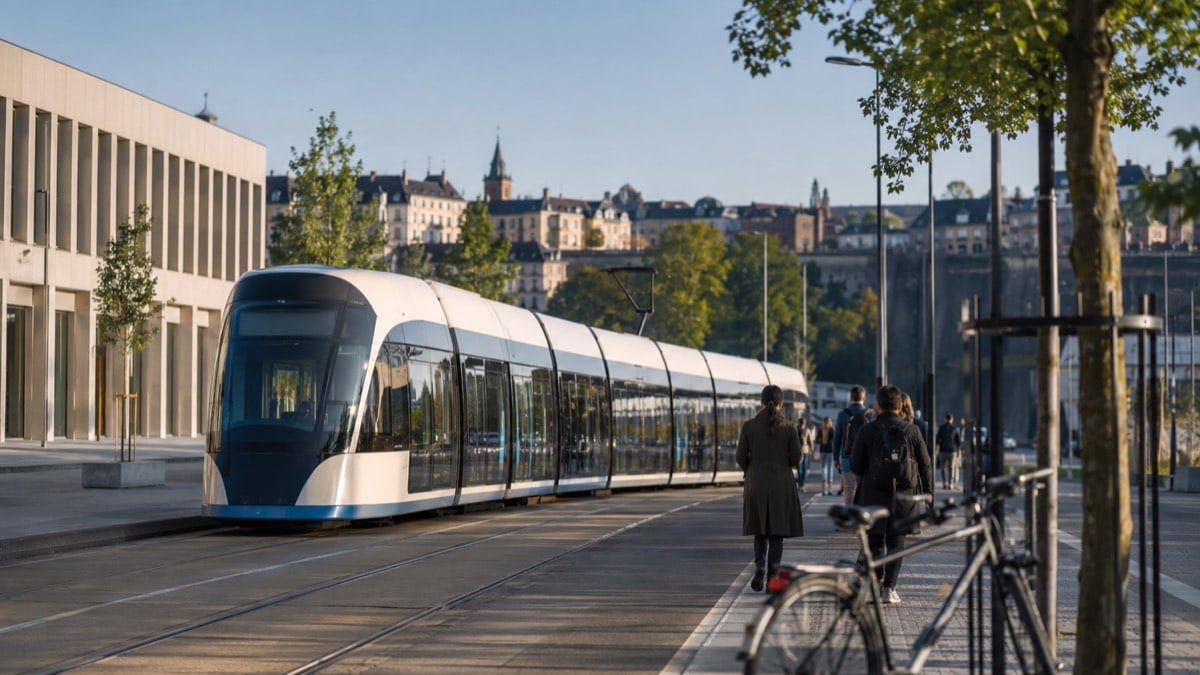
In 2020, Luxembourg became the first country in the world to make public transport free: buses, trams and second-class trains, across the entire national territory. For anyone moving into a shared flat here, that one fact can genuinely mean skipping a car altogether. This guide explains exactly what's free, what still costs money, and how to plan your daily commute by tram, bike or on foot.
Free public transport in Luxembourg: what's covered, what isn't
The free-of-charge policy covers buses, trams and second-class train travel for any journey that stays entirely within Luxembourg, regardless of your status: resident, cross-border commuter or visitor. There's nothing to buy and, in most cases, nothing to validate. You simply get on, sit down, and get off at your stop.
Two limits are worth knowing before you get too excited. First, first-class train carriages are not free; a supplement applies if you sit in a carriage marked as first class. Second, as soon as a train journey crosses the border, say towards Trier, Metz or Arlon, only the Luxembourg portion is free; the section travelled abroad is charged at the neighbouring country's or operator's normal fare.
How it actually works day to day
There's no card to buy and no ticket to validate for a standard second-class journey, which is the biggest practical difference from most European cities. For timetables, connections and live departures, the official Luxembourg mobility portal (mobiliteit.lu) and its companion app remain the reference: they cover the whole bus, tram and train network across the country in real time. That's particularly handy on weekday rush hours, when some bus routes get busier than usual.
The tram: the backbone of Luxembourg City
The tram runs north to south through the capital, connecting the Kirchberg plateau, home to many EU institutions and company headquarters, to the city centre and the central station, before continuing south towards Cloche d'Or, one of the city's main employment hubs. High frequency during peak hours and a central route make it the default spine of a car-free commute for a lot of residents.
Trains: reaching the country's main towns
The rail network is the natural complement to the tram once you head outside the capital: regular services connect Esch-sur-Alzette and the former mining basin to the south, or Ettelbruck and Diekirch to the north, along with several other towns on the main lines. For a flatmate who works outside Luxembourg City, or simply wants to explore the country on a weekend, free train travel is a genuine game-changer compared with countries where every ride adds up.
Cycling: bike lanes, bike-sharing and e-bikes
Luxembourg City sits on a plateau cut through by steep valleys, notably the Pétrusse and the Alzette, which makes some cycling routes genuinely hilly. The cycle-lane network has expanded significantly in recent years, particularly along the valleys and towards outlying districts. The city runs its own bike-share scheme (Vel'oh!) with docking stations spread across several neighbourhoods, handy for a one-off trip or to bridge the last stretch after a tram ride. For regular commuters, an electric bike is usually the more comfortable choice for handling the hills without arriving at the office out of breath.
Walking, public lifts and the funicular
The city centre is very walkable, as long as you're prepared for the elevation changes: the gap between the plateau and the valley-floor districts such as the Grund or Clausen is real. To avoid the climb, the city has installed several free public lifts, notably between the old town and the Grund, plus a funicular linking the central station to the Kirchberg plateau via the Pfaffenthal-Kirchberg bridge, with a direct connection to the tram. All of these are free, just like the rest of the network.
Do you still need a car when you live in a shared flat?
For most furnished.lu tenants, the answer is no, especially if the flat is well positioned relative to a tram stop or a train station. Owning a car in the city comes with real costs: fuel, insurance, maintenance and, above all, parking, which stays limited and paid in most central neighbourhoods (resident parking permits, where they exist, are requested from the local commune and aren't automatic or free). Car-sharing services fill the gap for the occasional trip where a car genuinely helps, without the commitment of owning one year-round. Many flatmates simply combine tram, bike and walking on weekdays, and reach for car-sharing only for a big shop or a weekend outside the network.
Choosing your neighbourhood based on your commute
This is often the most useful way to think about a car-free move: pick your room based on your daily commute rather than raw proximity to the city centre. If you work in Kirchberg, a room near a tram stop changes everything. If your job is closer to Cloche d'Or or further south, it's worth checking bus and tram connections before signing anything. Our neighbourhood price guide for shared flats helps you weigh budget against location, and our full checklist for settling in Luxembourg covers the other steps worth planning once you've found a place.
Getting to Luxembourg-Findel Airport
The airport is served by free bus routes from the city centre and the central station, with a journey time of roughly twenty minutes depending on where you start and traffic conditions. That's a real perk for expats who regularly fly home: no need to book an expensive taxi or ride-hailing car, the free bus does the job perfectly well for a flight with just cabin luggage.
So, which neighbourhood should you choose?
Ultimately, free public transport genuinely changes how you should think about housing in Luxembourg: the question is no longer "am I close to the centre" but "am I close to a tram stop, a bus line or a station that serves my workplace". That's exactly the logic we use when selecting our furnished residences. Browse the rooms currently available and filter by neighbourhood to find a place well connected to your daily commute, with no deposit and all bills included.
Find your room in Luxembourg
792 furnished rooms, all bills included, no locked deposit. Book online in minutes.
See available rooms